


Governing “Agentic AI”: The New Machine Identities in Your Network
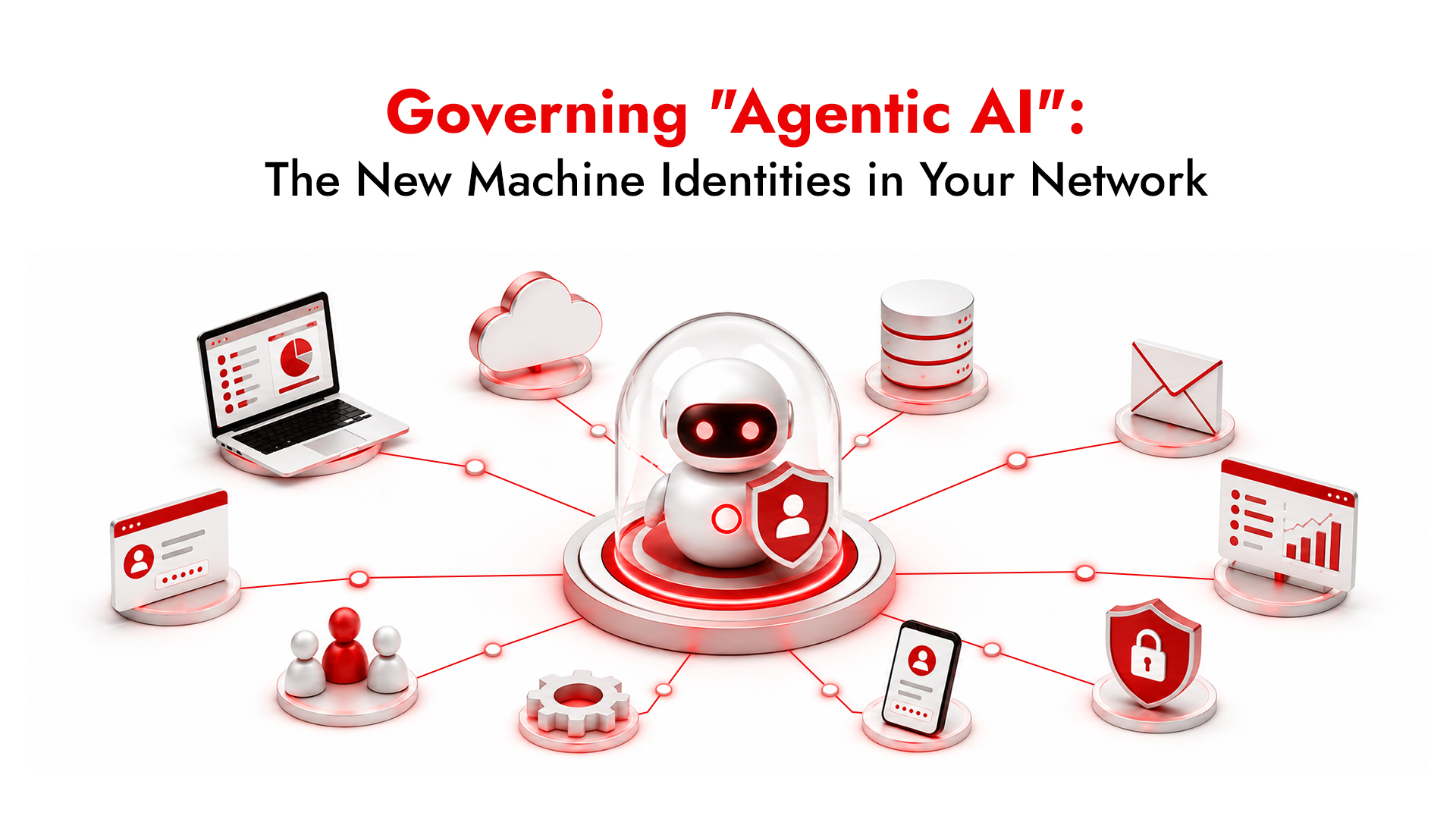
If your organization’s cybersecurity strategy is still focused primarily on securing human logins, you are guarding the wrong perimeter. Over the last few years, the corporate landscape has quietly shifted. We have moved rapidly from static, prompt-based chatbots to Agentic AI, ie. autonomous AI agents that don’t just answer questions, but independently plan, make decisions, call APIs, query databases, and execute workflows.
An agent that autonomously reconciles invoices, updates customer records, or provisions cloud infrastructure saves massive amounts of time. But it also introduces a highly complex security challenge. To do their jobs, these agents require administrative access keys, API connections, and credentials.
Industry data reveals that non-human identities (NHIs) now outnumber human users in enterprise environments by as much as 82 to 1. Unsurprisingly, 48% of cybersecurity professionals now rank agentic AI and autonomous systems as their top emerging attack vector. Yet, only a fraction of organizations are prepared to govern them.
Here is why Agentic AI is breaking traditional Identity & Access Management (IAM), and how your organization can establish a secure framework to govern these new machine workforces.
Why Agentic AI Breaks Traditional Identity & Access Management
Traditional IAM and Identity Governance (IGA) frameworks were built on a simple premise: a human user logs in, completes multi-factor authentication (MFA), and performs a predictable set of actions within a defined session. Autonomous AI agents do not fit this mold. They operate continuously, at machine speed, and frequently without any human supervision.
When organizations attempt to integrate these agents into legacy systems, they usually rely on static service accounts, shared API keys, or long-lived tokens as stand-ins for machine identity. This practice exposes several massive security gaps:
1. Privilege Escalation Without Review
Because agents need to call multiple tools and databases to complete complex tasks, they are often granted overly broad permissions. Over time, as an agent’s capabilities are upgraded, it retains legacy, high-privilege access to sensitive systems without any formal security review.
2. Impersonation vs. Delegation
When an AI agent acts on behalf of an executive, it often uses that executive’s standing credentials to access downstream databases. In your system logs, the agent’s actions are indistinguishable from the human’s. If an agent misinterprets a goal or is manipulated, there is no reliable way to prove whether a human or an autonomous script initiated the action.
3. The Threat of “Goal Hijacking” and Tool Misuse
Unlike standard software, the execution path of an AI agent is unpredictable. Threat actors do not need to steal an agent’s password to exploit it. By executing a prompt injection attack, an adversary can manipulate the agent’s reasoning loop, tricking it into misusing its authorized tools, such as ordering it to export a sensitive database to an external IP.
The Four Pillars of Agentic Identity Governance
Securing an “agentic enterprise” requires extending the same rigorous lifecycle and governance principles to AI agents that you already demand for your human workforce. To govern machine autonomy safely, your security framework must be built on four core pillars:
Pillar 1: Discovery & Non-Human Identity (NHI) Registration
You cannot protect what you cannot see. The first step in securing your ecosystem is eliminating Shadow AI, unauthorized agents or integrations connected to your network by well-meaning employees.
- The Action: Treat every AI agent, Model Context Protocol (MCP) server, and automation script as a distinct, first-class non-human identity.
- The Standard: Register them formally within your identity directory with defined owners, explicit operational scopes, and strict lifecycle limits.
Pillar 2: Dynamic, Runtime Identity (Least-Privilege Scoping)
Static, standing credentials are an open invitation to lateral movement. If an agent is compromised, an attacker can use its persistent API keys to access adjacent servers.
- The Action: Transition from static credentials to runtime identity evaluation.
- The Standard: Enforce short-lived, task-scoped credentials that authenticate at the exact moment of an API or tool call. Access should automatically expire the millisecond the specific task is complete.
Pillar 3: Authenticated Delegation (Not Impersonation)
When an agent executes an order on behalf of a human, it must never impersonate them.
- The Action: Implement cryptographic tokens that mathematically tie the agent’s machine identity to the specific, verified human who authorized the request.
- The Standard: This “transitive trust” ensures the system validates both who gave the order and what the agent is allowed to do, preventing unauthorized horizontal privilege jumps.
Pillar 4: Human-in-the-Loop (HITL) Guardrails & Reasoning Audits
Autonomous execution must have limits.
- The Action: Define rigid thresholds for high-risk operations, such as bulk data exports, financial transfers, or security configuration changes.
- The Standard: These high-risk tasks must trigger a “step-up” challenge requiring explicit human approval before the agent can proceed. Additionally, maintain an immutable reasoning audit trail to log not just what the agent did, but the logical steps it took to arrive at that decision.
Moving Forward: Bridging the Governance Gap
The rapid deployment of Agentic AI is a massive operational win for modern businesses, but automation must never outpace governance. Security teams cannot rely on outdated, static IAM tools to monitor dynamic, self-reasoning software operating at machine speed.
At Cyber1Armor, we help organizations build resilient, balanced security postures. Our Identity & Access Management (IAM/IGA) specialists work with you to:
- Map and discover hidden Non-Human Identities (NHIs) and Shadow AI connections across your hybrid cloud ecosystem.
- Design and deploy secure identity delegation policies to ensure AI workflows are auditable and compliant.
- Align your automated systems with modern Zero Trust security standards, limiting blast radiuses and securing critical corporate databases.
Don’t let autonomous agents become unmonitored backdoors into your network. Contact the experts at Cyber1Armor today to establish a resilient, auditable Identity Governance framework for your automated workforce.